The Main Danger of Air Pollution in Cities for Human Health
More than half of the world’s population lives in highly urban ares.1 Human living in a increasingly dense cities is relevantly a new phenomenon in human history. According to the United Nations’ prediction, the urban population is going to keep increasing in the future.2 Living in a dense city have many benefits, which is why people all over the world are moving from rural to urban areas. But a wise man once said, for every action there is an equal and opposite reactions.3 The same goes for living in dense cities for human health. Life in city has negative affect on both mental and physical health.4 Today I am going to focuses on the negative effect of the human physical health, mainly the danger of air pollution in cities.
Obesity has been increasing all around the world in recent years. Especially young adults living in dense cities.5 Most people blame this on personal habit and being lazy all around. Also, not having access to healthy foods and water. At first the epidemic of obesity will not look like it is related to the air we breathe. But it is very much true. Personal habit and consuming unhealthy food is causing obesity, but a recent study from China show us a another reason for childhood obesity in recent years. According to the research, which synthesized data from seven other studies found that daily exposure to particulate matters PM1, PM2.5, PM10, nitrogen dioxide, sulfur dioxide, and ozone are linked with higher obesity rate among children and adolescents.6
China is a developing country which is modernizing very fast. In present day, China is releasing more green house gases than all the developed nation combined.7 The country of China also heavily rely on coal to power their power plants. In the past few decades the populations of China also owning cars a lot. The number of cars per 100 households in Urban area increased from 22.3 in 2013 to 55.9 in 2023.8 All these factors are causing a huge amount of air pollution in China’s urban area. There cities are covered with smog in the air. Public are warned that the visibility could drop to less than 50 meters or 164 feet.9 The smog that are covered in China’s sky are mostly particulate matters that are smaller than human hair and mostly produced from chemical reactions inside power plants, factories and cars.10 The study from China found that when a child gets expose to this chemical that are abundance in the air of our cities, causing a metabolic disruption and inflammatory responses, which may lead to increased fat storage. (Luo, Chengwen, Page 6) So from this study, we can see that air pollution are causing the spike in obesity and overweight among our children. The idea that air makes people fat sounds ludicrous, but according to the study appear to be showing it is possible. When people are exposed to harmful particulate matter such as PM1, PM2.5, PM10, their body releases a type to hormone that reduce the insulin’s potency and draws blood away from the sensitive muscle tissue. This prevents the body from controlling blood surge level. Which cause the human body to make access amount of fat. The hormone that educe the insulin’s potency can also trigger inflammation that interferes with human brain’s ability of govern appetite. This can cause someone to eat more that they need in a day. So two people can eat the same amount of foods and exercise the same, but over time one might put more fat-weight than the other just because they live in a particulate matters polluted city. People do not have control over the atmosphere around their home, but the society blames the individual for health issue related to obesity or overweight.
If a person does not live in a particulate matter polluted city, but their mother was during pregnancy they can have negative health affect during there life. According to the National Library of Medicine, exposed to particulate matter PM2.5 is associated with increase risk of premature birth.11 For a baby premature birth can cause a huge amount of short and long term complications. According to the Mayo Clinic Organization, child born prematurely can have metabolism problems. Many premature babies have a very small level of blood sugar compared to a full-term baby.12 The metabolism problems of a premature baby is usually a short-term issue, but sometimes this can become a long term complications, which can cause obesity related issues in adulthood. The obesity problem is not going to get any better if we do not factor in the air to the equations. People all over the world have been consuming unhealthy food and water from the beginning of time, but the epidemic of obesity is a 20th century problems.13 This is the time period when people moved to cities from rural in masses and factories, cars and power plants became super common around us.14
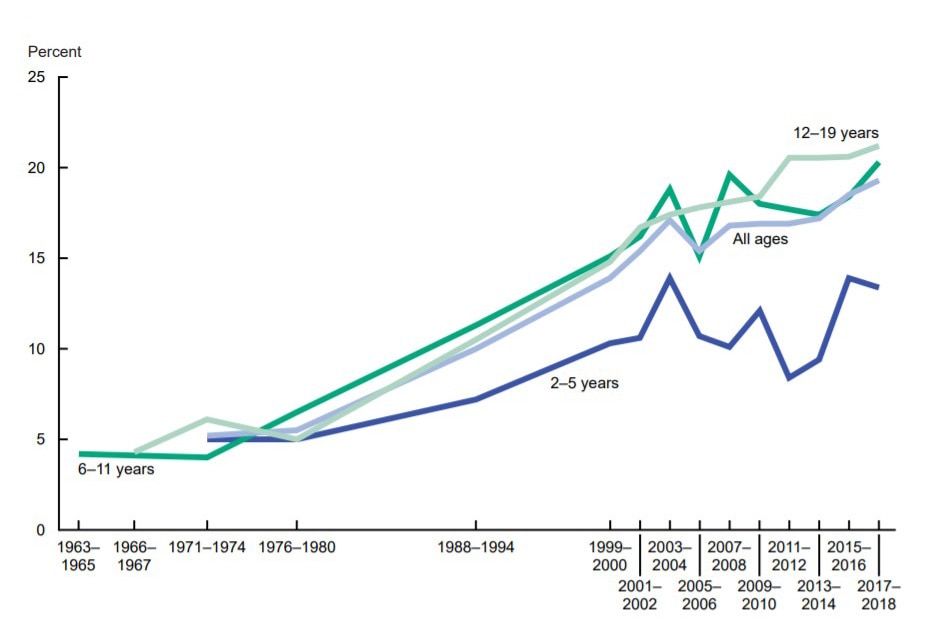
Obesity Rates of the U.S. Population (1963–2018)
The graph above is from the NIDDK, United States National Institute of Diabetes and Digestive and Kidney Diseases Organization, show how the obesity of the United States has exponentially increased after the 1950s.22 After the World War II, the car ownership and United States population moving to the cities and suburb increased for better quality of life.23 So, we can conclude that as the car in our neighborhood increased the obesity rate also increased with it. The particulate matters from cars, especially during the early days between the 1970s to the 1990s caused the most amount of damage. In the graph we can see that in the early 2000s, the increase in obesity rates dropped a bit, this can be because of the automobile emission standards that were put into place by the US Federal Government. In the early 2000s to present day the emissions of car improved a lot, because of modern technology and emission laws which made the air round us much cleaner. This might be one of the reason the obesity rate in the United States also improved a little.
This is the graph of the emission standard set my United States government which improved internal combustion engine’s exhaust emission. Cars are the biggest air pollutants in neighborhood across the United States.24 New emission laws for car and giving tax break to new clean car will improve air in the United States neighborhood which might decrease the obesity rates.
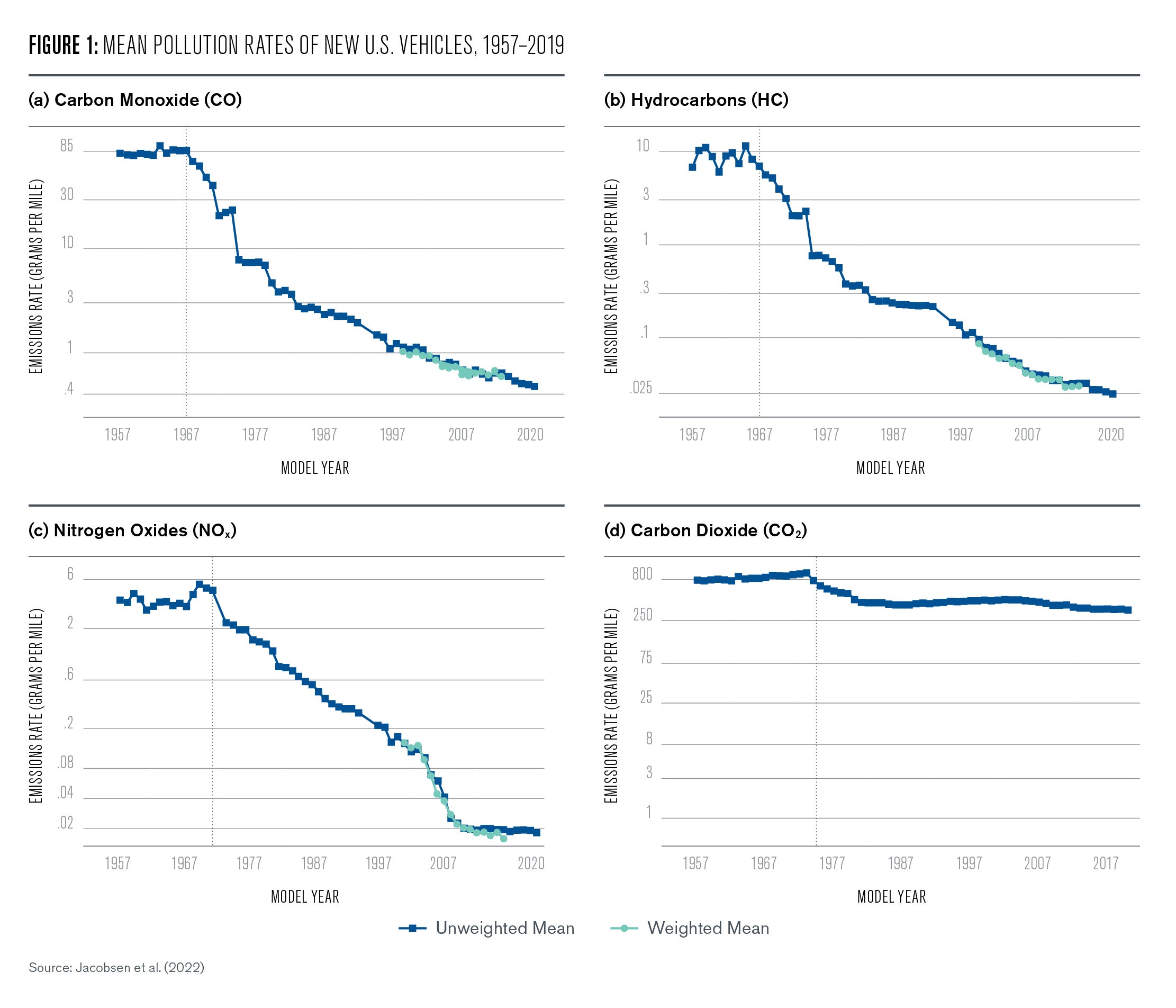
Exhaust Standards and Emissions for Hydrocarbons from 1982 to 2010
Source: Jacobsen et al. (2022)
People living in cities have a higher chance of getting infected by airborne diseases like flu and Coronavirus.15 This is because of the proximity people live in cities. But the air pollution has a bugger impact on people’s respiratory diseases than the proximity. According to the Bio Med Center, in a study from Japan found that exposed to the particulate matter PM1, PM2.5, PM10, during pregnancy can cause the child to develop a very weak immune system.16 As the child grow older this problem gets better over time. But if that child continues to live in that city where the mother got exposed to particulate matter, then the immune of system of that person will not improve decreasing pathogen response gene expression, according to a study from PubMed Central by scientist Zhang, Weiwei.17
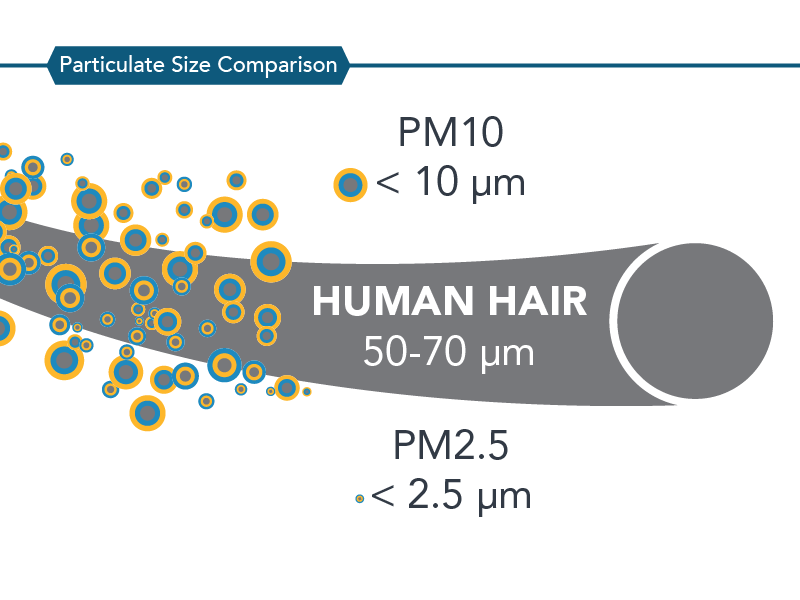
Particulate Size Comparison — California Air Resources Board25
This can change the outcome of a nation’s pandemic response. This is exactly what a peer-reviewed studly from the state of Indiana, United States, found during the COVID-19 pandemic. The peer review study from the state of Indiana in the United States found relationship between short-term air pollution and COVID-19 death in December 2020.18 There finding is very slimier to the study from China, which we looked into before. According to this study in Indiana, researcher looked into people who died from COVID-19 were cases and who lived were controls. The finding highlights that even a small number of exposure to particulate matter such as PM2.5 and PM10, same as the Chinese study, caused more deaths. On average 2.7 folds to 4.6 folds increase of COVID-19 moralities among patients who were exposed to NO2 also known as nitrogen dioxide and-or particulate matters. (Heilers, Anna E., and Sarah A. Bennett. Page 11) So, by analyzing this finding we can conclude that just by making our air free of pollution from car, factories and power plants we could have prevented one of the deadliest pandemic in our lifetime.21
The immune system of our body is a large network of organs like white blood cells, proteins and different chemical that all work together to protect us from millions of germs and other invaders that are trying to make us sick every day.19 The conditions of the immune system depend on what kind of food, water and air a person is surrounded by every day. Consuming unhealthy foods and water will decrease the power of the immune system to mobilizes and kills germs that are trying to harm that person.20
This is where the particulate matter in air pollution comes into play. People who are living in polluted cities are getting sick from airborne related diseases. Not only for living in close quarter with each other or consuming unhealthy food, but also because of the air that they breathe every day. Which they do not have any control over. In the study from Indiana, United States we can see that people are paying with their life for the pollution that factories, power plants and cars caused. Many people who died in different cities in the state of Indiana or any other state throughout the United States was not because they did not follow the government mandate or consumed unhealthy food. According to the studies from the scientist, Heilers, Anna E., and Sarah A. Bennett, a lot of COVID-19 death caused by air pollutants such as PM1, PM2.5, PM10, nitrogen dioxide, sulfur dioxide which weaken the immune-system of the human body. In order for us as society to prevent deadly pandemic like the COVID-19, we have to clean the air in our cities. In the future, if another airborne related pandemic comes then just staying in home and getting vaccinated will not do much if we are all breathing air filled with particulate matters.
The danger of air pollution in cities is far extended the commonly understood respiratory issues. From increasing obesity rate to weakening immune system, the evidence strongly supports that air pollution driven by particulate matters (PM1, PM2.5, PM10), nitrogen dioxide, sulfur dioxide is the silent contributor of the modern health crises. Urbanization and industrialization has massive benefit to a country and human life-style but the byproduct of all this advancement namely air pollution have produced significant cost on human health. Most of the time people who are producing these pollutants in our neighborhood are not facing the consequences of their actions. The COVID-19 pandemic highlighted the deadly consequences of polluted air, as those exposed to poor air quality faced higher mortality rates.
All this finding shows us that to fix this we need to work together putting aside all our differences. We need new laws regulating pollutants coming from factories, cars and power plants. Unnecessarily heavy pick-up trucks and big engine cars should be regulated for daily use by a normal people without special license. Our nation need to focus more on environmentally friendly public transportation networks like in Europe and Japan. If we put our mind to it we can achieve clean air cities all over the United States. We landed on the surface of our Moon in the 60s and this 2024, we are talking about. By addressing the root causes of air pollutants we can ensure a heather and more sustainable urban future.
Annotated Bibliography
Luo, Chengwen, et al. “The Association between Air Pollution and Obesity: An Umbrella Review of Meta-Analyses and Systematic Reviews.” BMC Public Health, vol. 24, 2024, p. 1856, https://doi.org/10.1186/s12889-024-19370-4. Accessed 11 Oct. 2024.
The obesity in the world has triple in the World since 1975. Air pollutants coming from the burning of fossil fuels such as PM1, PM2.5, PM10, O3, CO and NO2 etc and their complex mixture are harmful to human health. In China animal studies conforms that expose to this particulate matter activate genes that are related to fat productions. The author also found positive correlations between air pollution and obesity, especially among children and adolescents. There are still some gapes in the research, according to the author. Need more studies to find clarify biological mechanisms that is linking air pollutants to obesity. This support my ideas because it shows that air pollution also has negative affect on human body fat.
“Pollution – Air Pollution Kills 238,000 European Prematurely.” RFI, 24 Nov, 2022, p. NA. SyndiGate Media Inc, Gala Business: Insight.
News paper article reporting study by the European Environment Agency, where fine particulates in the air caused around 238,000 premature death in the continent of Europe. More that 96% of the EU urban populations are expose to dangerous laves to fine particulate matters. The COVID-19 lock-down did not lower the air pollution. The tiny size of these particulates matter enables them to travel far inside of human lungs, worsening the risk of serious lung disease. This article is helpful to me because this shows that mostly population in cities suffering from this.
Heilers, Anna E., and Sarah A. Bennett. “Air Pollution and COVID-19 Mortality: A Case-Control Study of COVID-19 Cases Reported in Indiana in 2020.” Journal of Environmental Health, vol. 9, Sept. 2024, pp. 8-12.
This study finds the relationship between air pollution and COVID-19 mortality in Indiana, United States during 2020. This study used over 53,000 COVID-19 patients to determine whether short-term exposure to air pollutants like PM2.5, PM10, and Nitrogen Dioxide increased the risk of death. The study found that exposure to PM10 raised the risk of COVID-19 mortality. Additionally, the study found that exposure to NO2 had a healthy effect on patients with per-existing lung conditions. The author believes this is due to the protective nature of nitrogen oxide. In conclusion, the author suggests that stricter pollution control can reduce COVID-19 mortality or diseases like COVID-19.
Notes
- Ritchie, Hannah, et al. “Urbanization.” Our World in Data, 23 Feb. 2024, www.ourworldindata.org/urbanization. Accessed 16 Nov. 2024.
- “68% of the World Population Projected to Live in Urban Areas by 2050, Says UN | UN DESA | United Nations Department of Economic and Social Affairs.” www.un.org/development/desa/en/news/population/2018-revision-of-world-urbanization-prospects.html. Accessed 16 Nov. 2024.
- Helmenstine, Anne Marie, PhD. “What Are Newton’S Laws of Motion?” ThoughtCo, 16 July 2024, www.thoughtco.com/what-are-newtons-laws-of-motion-608324. Accessed 16 Nov. 2024.
- Xu, Jiayuan, et al. “Effects of Urban Living Environments on Mental Health in Adults.” Nature Medicine, vol. 29, no. 6, June 2023, pp. 1456–67. https://doi.org/10.1038/s41591-023-02365-w. Accessed 16 Nov. 2024.
- World Health Organization: WHO. Obesity and Overweight. 1 Mar. 2024, www.who.int/news-room/fact-sheets/detail/obesity-and-overweight. Accessed 16 Nov. 2024.
- Luo, Chengwen, et al. “The Association Between Air Pollution and Obesity: An Umbrella Review of Meta-Analyses and Systematic Reviews.” BMC Public Health, vol. 24, 2024, p. 1856, doi:10.1186/s12889-024-19370-4. Accessed 16 Nov. 2024.
- BBC News. Report: China Emissions Exceed All Developed Nations Combined. 7 May 2021, www.bbc.com/news/world-asia-57018837. Accessed 16 Nov. 2024.
- Statista. “Number of Cars per 100 Households in Urban and Rural China 2013-2023.” Statista, 15 Nov. 2024, www.statista.com/statistics/233678/number-of-cars-per-100-households-in-china-by-income. Accessed 16 Nov. 2024.
- “China’s Smog-Covered North on Highest Pollution Alert as Visibility Drops.” Reuters, 31 Oct. 2023, www.reuters.com/world/china/chinas-smog-covered-north-highest-pollution-alert-visibility-drops-2023-10-31. Accessed 16 Nov. 2024.
- “Particulate Matter (PM) Basics | US EPA.” US EPA, 20 June 2024, www.epa.gov/pm-pollution/particulate-matter-pm-basics. Accessed 16 Nov. 2024.
- Ciencewicki, Jonathan, and Ilona Jaspers. “Air Pollution and Respiratory Viral Infection.” Inhalation Toxicology, vol. 19, no. 14, 2007, pp. 1135-1146. PubMed Central (PMC), www.ncbi.nlm.nih.gov/pmc/articles/PMC4714531. Accessed 16 Nov. 2024.
- Mayo Clinic Staff. “Premature Birth: Symptoms and Causes.” Mayo Clinic, Mayo Foundation for Medical Education and Research, 15 Oct. 2022, www.mayoclinic.org/diseases-conditions/premature-birth/symptoms-causes/syc-20376730. Accessed 16 Nov. 2024.
- Cooper, Charlie. “The Origins of the Obesity Epidemic May Be Further Back than We Thought.” Science, American Association for the Advancement of Science, 2 Oct. 2023, www.science.org/content/article/origins-obesity-epidemic-may-be-further-back-we-thought. Accessed 16 Nov. 2024.
- “America Moves to the City.” Khan Academy, www.khanacademy.org/humanities/us-history/the-gilded-age/gilded-age/a/america-moves-to-the-city. Accessed 3 Oct. 2024. AND History.com Editors. “Automobiles.” History, A&E Television Networks, 14 Apr. 2010, www.history.com/topics/inventions/automobiles. Accessed 16 Nov. 2024.
- Rogers, Adam. “How Does a Virus Spread in Cities? It’s a Problem of Scale.” Wired, 20 May 2020, www.wired.com/story/how-does-a-virus-spread-in-cities-its-a-problem-of-scale. Accessed 16 Nov. 2024.
- Yoshida, Tetsuji, et al. “Air Pollution and Child Health: Cohort Study on Effect of Air Pollution on Birth Outcomes in Japan.” Environmental Health and Preventive Medicine, vol. 26, no. 77, 2021, environhealthprevmed.biomedcentral.com/articles/10.1186/s12199-021-00995-5. Accessed 16 Nov. 2024.
- Zhang, Weiwei, et al. “The Association Between Long-Term Exposure to Air Pollution and Chronic Diseases: A Systematic Review and Meta-Analysis.” Environmental Health Perspectives, vol. 131, no. 8, 2023, p. 87001. PubMed Central (PMC), www.ncbi.nlm.nih.gov/pmc/articles/PMC10406897. Accessed 16 Nov. 2024.
- Heilers, Anna E., and Sarah A. Bennett. “Air Pollution and COVID-19 Mortality: A Case-Control Study of COVID-19 Cases Reported in Indiana in 2020.” Journal of Environmental Health, vol. 87, no. 2, Sept. 2024, pp. 8-12. National Environmental Health Association. Accessed 16 Nov. 2024.
- Cleveland Clinic. “Immune System: What Is It and How Does It Work?” Cleveland Clinic, 13 Oct. 2023, my.clevelandclinic.org/health/body/21196-immune-system. Accessed 16 Nov. 2024.
- WebMD Editorial Staff. “How You May Be Weakening Your Immune System.” WebMD, 2024, www.webmd.com/cold-and-flu/ss/slideshow-how-you-suppress-immune-system. Accessed 16 Nov. 2024.
- The Washington Post Staff. “History’s Deadliest Pandemics, From Ancient Rome to Modern America.” The Washington Post, 7 April 2020, www.washingtonpost.com/graphics/2020/local/retropolis/coronavirus-deadliest-pandemics. Accessed 27 Oct. 2024.
- National Institute of Diabetes and Digestive and Kidney Diseases. “Overweight and Obesity Statistics.” National Institute of Diabetes and Digestive and Kidney Diseases, U.S. Department of Health and Human Services, 2021, www.niddk.nih.gov/health-information/health-statistics/overweight-obesity. Accessed 16 Nov. 2024.
- ‘The American Automobile Frenzy of the 1950s’, The Challenge of Affluence: Self-Control and Well-Being in the United States and Britain since 1950 (Oxford, 2007; online edn, Oxford Academic, 3 Oct. 2011), https:www.//doi.org/10.1093/acprof:oso/9780199216628.003.0009. Accessed 17 Nov. 2024.
- New York City Department of Health and Mental Hygiene. “Car-Free Zones: Creating Safer, Healthier Streets.” NYC Health, 2024, a816-dohbesp.nyc.gov/IndicatorPublic/data-stories/car-free-zones. Accessed 16 Nov. 2024.
- California Air Resources Board. “Inhalable Particulate Matter and Health.” California Air Resources Board, 2024, ww2.arb.ca.gov/resources/inhalable-particulate-matter-and-health. Accessed 16 Nov. 2024.